

London’s reputation as a potent international retailing destination was underlined last week as almost 1,000 senior industry figures attended the 18th edition of World Retail Congress.
Back in its home base for the first time since 2012, the two-day conference covered most significant sectors, from luxury fashion to discount supermarkets. Delegates at the London Hilton on Park Lane were presented with a slickly-organised and packed programme of keynote addresses, discussion panels, fireside chats and break-out mini-sessions.
Although aimed at “big” players from global retail, there was plenty of information on offer that was relevant to indie retailers and smaller fashion brands.
In the opening keynote address last Tuesday (May 13), Ken Murphy, CEO of the UK’s biggest retailer Tesco, shared some pertinent insights that should resonate with any capable independent.
The supermarket’s success depends on the customers’ trust and on being a part of its communities, the quietly-spoken Irishman asserted. “Doing the right thing always made good business sense” was his message.
Repeating the oft-heard line that “rarely have things been as challenging as they are today,” Murphy insisted: “Trust doesn’t follow success, it drives it”. For shoppers to engage with a retailer, they have to believe the business does good.
Tesco’s Clubcard will celebrate 30 years this year and Murphy said the company is currently trialling personalised Clubcard prices: “To do the right thing you have to understand (the customers, who) want to know they are buying from companies that align with their values.”
Surely this personal knowledge of customers is a central plank of the success of any indie store, as is its role as an important part of a local community – another point that Murphy said Tesco achieved.
One of the more interesting aspects of the WRC’s approach is to have industry leaders interviewing their peers. JD Sports CEO Régis Schultz did a good job of questioning Britt Olsen, COO of fast-growing Swiss sportswear brand On (main image), which is now 15 years old and is expecting global sales this year equivalent to £2.6 billion.
Even with the advantage of Roger Federer being a founding shareholder, the company has done remarkably well in a market sector dominated by huge global brands. “Seeing a brand grow that was dominated by big players in the market is never down to just one thing,” said Olsen. “Coming into an industry of giants, it was an advantage being the underdog. Our success is also down to naivety and blind optimism. Culturally we have a strong focus on innovation too.”
She added that in the American market especially, the Swiss flag on the shoes was seen as indicating quality, reliability and “premiumness”.
Olsen also stressed On was doing well with its sportswear clothing, which prompted Schultz – whose JD is a stockist of the brand – to quip: “Yes but it’s quite expensive!”
An On women’s running jacket on the JD website is £180, a men’s T-shirt is £60.
There was more humour when the subject of consumers’ attitude to sustainability was discussed. In a survey conducted by On in New York City, when consumers were asked what sustainability meant for them, a common answer was: “Keeping my sneakers whiter for longer”.
“I’m often asked if our customers care (about sustainability) and the truth is they don’t. But we do!” Olsen added. “We want to be sustainable because it’s a key value. We care and we make sure we invest in sustainability – which is very Swiss. How we talk about sustainability is a constant point of discussion for us.”
Olsen added that maintaining a balance between DTC and having wholesale partners was key to its future growth, which may bring a wry smile from some early-adopting UK indies that On axed in recent years.
Helena Helmersson, former H&M CEO
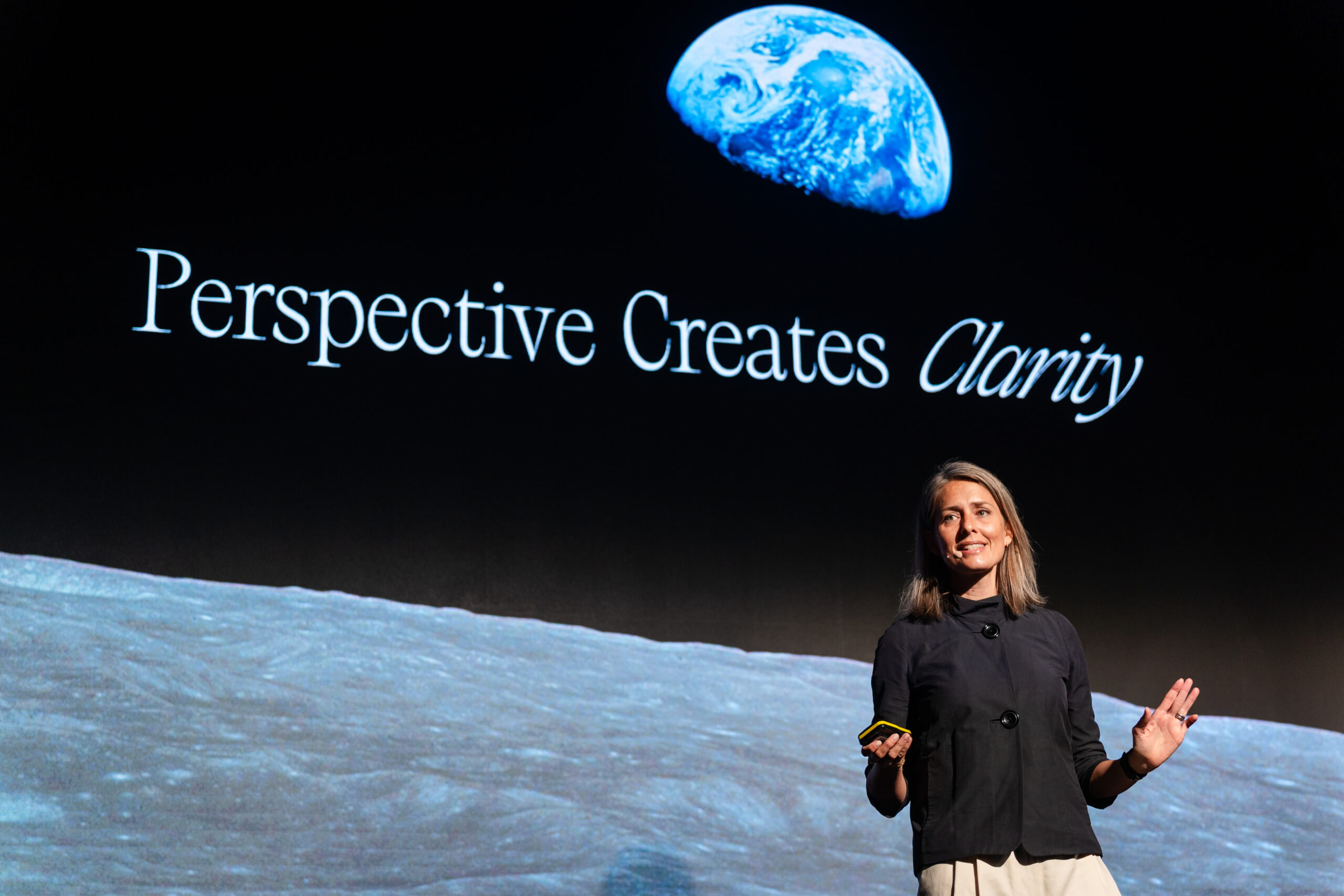
Sustainability in fashion was also the topic of a thought-provoking presentation by Helena Helmersson, who exited H&M a year ago after 20-plus years at the Swedish company, including her final four as CEO.
She highlighted the ever-present tension between sustainability goals and the business-as-usual demands within a company, across consumers and throughout the entire supply chain.
In her analysis she said we have moved from a phase around 2020 where the sustainability space was filled with big promises and green visions for the future, and now, with unpredictable events happening continuously, in 2025 we’re in the Valley of Disillusionment.
The next phase, running up to 2030, will be about moving up the Slope of Enlightenment, creating real value, moving away from big headlines to actually making impact. But it’s up to industry leaders to ensure sustainability is part of the core to strengthen our businesses.
In Helmersson’s view, top management’s job is to design a system to help the organisation succeed with sustainability and profitability. Make it simple for the many and complex for the few is her mantra.
To influence customers’ behaviours we need to understand their needs and create solutions to meet them, she maintained. We need to make sure that sustainability is good for people’s wallets, that it makes life easier, and creates true value.
She highlighted H&M’s partnership with Sellpy, a Swedish platform for selling secondhand clothes online.
On the huge task of shifting industry attitudes, she said we need to move away from checking boxes and scratching the surface. We need build deep and find the right partnerships to actually solve the issues and, step by step, change the system, she said (without going in to how this could be achieved)

Jamie Salter (l) of Authentic Brands Group
While sustainability was high on some people’s agenda, selling lots more stuff more often was a predictable preoccupation of many at WRC. Prime among these is the US-based Authentic Brands Group (ABG), which has partnered with American store group Saks Global to launch a platform called Authentic Luxury Group (ALG).
The intention is to create what has been described as “a $9 billion luxury ecosystem” over the next few years.
Opening the second day of WRC Jamie Salter, the Canadian billionaire founder of ABG, which owns (or manages) around 50 brands as varied as Ted Baker, Juicy Couture, Brooks Brothers and David Beckham, shared this ambitious vision in conversation with Richard Baker, executive chairman of Saks Global.
ALG has formed a partnership with Amazon to better analyse customer data and the two execs agreed that “in five years luxury is going to be natural on Amazon”. Conversely, the traditional department store model of Saks Fifth Avenue is being rationalised with around 600 suppliers (from a total of about 2,660) being dropped, mainly because they do not provide a guaranteed margin of 60% and more.
“In luxury the power has been at the vendor (supplier) level and we need to shift it towards the retail level,” the pair maintained.
While the numbers discussed here are in another galaxy compared to independents’ turnovers, the principle of tightening up on financial performance as opposed to keeping brands because of image, reputation or just long relationships is a compelling one.
Part of the ALG strategy is to stretch retail and fashion brands into hospitality and entertainment. Salter asserted: “We’ll see Saks branded residences going out, which also means people will buy home products for those. We have projects on the go. People in the Middle East and Asia Pacific (are) looking at doing a Saks store, a condo and an hotel.”

Marisa Gardini (r) of Prosper Brands
Luxury brand extensions were also mentioned by Marisa Gardini, CEO of New York-based consultancy Prosper Brands and former CEO of American designer name Isaac Mizrahi.
Talking about what luxury brands need to do to succeed, she stressed maintaining true quality and providing an in-store sense pf experience.
Stores should be more than places full of hanging clothes. Gardini likes the cafes that Prada has in some of its stores and highlighted a temporary Louis Vuitton store in Manhattan that includes a chocolate shop and a restaurant.
She also urged luxury brands to remember that 20- and 30-year-olds now have more money at a younger age than ever before. Brands need to aim marketing at them and not just 50- and 60-year olds.
“Gen Alpha are smart and they say ‘Tell me why I should buy something’. Brands need to lower entry prices so younger consumers can buy at least one item from the brand, even if it’s only a luggage tag,” she said. “Luxury brands also need to be less serious and more playful. But they must maintain transparency and honesty. No consumer wants to see a brand pandering to them – whatever they do has to make sense (for their brand values).”

Menswear designer Todd Snyder
Act faster, bolder, smarter was one of the key messages from the conference and the state of the world was summed up well by American menswear designer Todd Snyder, who commented: “Retail’s not dead, but mediocre retail is dead.”
For 2026 WRC is moving on to Berlin, where it take place on 27-29 April at the Intercontinental Hotel.